 blog
Are Consulting Services for Dealership Profitability Worth It?
Last Updated: November 15, 2026
Quick Summary
Consulting services for dealership profitability are worth it when they target the hidden losses most stores never review, such as unused software, duplicate tools, billing errors, and outdated contracts. An independent expense audit reviews vendor agreements line by line and sells no software, so findings turn into verified savings rather than a strategy deck.
- Profit leakage usually hides in DMS and CRM contracts, duplicate tools, billing errors, and auto-renewing service agreements.
- Generalist firms cover sales, F&I, and strategy, while independent auditors focus on contract-level expense detail.
- Ask providers to state their baseline, period, net-versus-gross savings, and who verifies the numbers.
- Score providers on independence, written scope, implementation support, and fee transparency before signing.
- ALL RELATIVE INC. brings over 20 years of dealership experience and sells no software or vendor representation.
Table of Contents
- Why Dealership Profitability Consulting Is Growing in 2026
- Comparing Consulting Models: Generalist Firms vs. Independent Expense Auditors
- What an Automotive Dealership Expense Audit Actually Covers
- Inside a Dealership Vendor Contract Review: DMS, Technology, and Service Agreements
- DMS Cost Reduction Strategies That Protect Gross Profit
- How to Evaluate ROI, Fees, and Engagement Length Before You Sign
- A Provider-Selection Framework for Dealership Profitability Consulting
- Find My Profit Leaks: Your Next Step With All Relative Inc.
- Frequently Asked Questions
Why Dealership Profitability Consulting Is Growing in 2026
Dealership profitability consulting exists because most stores lose money in places nobody is watching. At ALL RELATIVE INC., we have spent years inside dealership financials, and the pattern repeats: the biggest losses rarely come from the sales floor. They come from software subscriptions nobody canceled, invoices nobody reconciled, and contracts nobody renegotiated.
That is why consulting services for dealership profitability have moved from luxury to necessity. Margins are thinner, technology stacks are more complex, and vendors have gotten very good at billing quietly.
Where Profit Leakage Hides in a Modern Dealership
Profit leakage in a dealership is the slow drip of money leaving through recurring expenses, duplicate products, billing errors, and contract terms that no longer match what the store actually uses. It rarely shows up as one dramatic loss. It shows up as dozens of small ones.
The usual hiding places:
- DMS and CRM contracts with services bundled in that no department uses
- Duplicate tools where two vendors provide overlapping functionality
- Billing errors on invoices that get approved without a line-by-line check
- Service agreements auto-renewing at rates set years ago
- Fixed operations and parts department subscriptions tied to outdated processes
None of these require a crisis to fix. They require someone to look.
Comparing Consulting Models: Generalist Firms vs. Independent Expense Auditors
Two models dominate this space, and they produce very different outcomes. A generalist consulting firm typically delivers broad operational reviews, which can be valuable when a store needs strategy.
An independent expense audit focuses on line-by-line review of vendor contracts, technology spend, and recurring billing, with no software to sell.
| Model | Typical Scope | Best For | Main Trade-off |
|---|---|---|---|
| Generalist consulting firm | Sales performance, F&I, fixed operations, business strategy, leadership development | Stores needing a full operational assessment and growth plan | Broad focus can leave contract-level expense detail untouched |
| Independent expense auditor | DMS, technology, vendor contracts, billing accuracy, recurring costs | Stores with complex vendor stacks and rising overhead | Narrower scope, so pair it with operational planning elsewhere |
If you want to see what that second model includes before committing, review the dealership consulting services that protect profit.
What an Automotive Dealership Expense Audit Actually Covers
An automotive dealership expense audit is a structured, line-by-line review of every vendor relationship and recurring charge, matched against what the store actually needs and what the market charges for it.
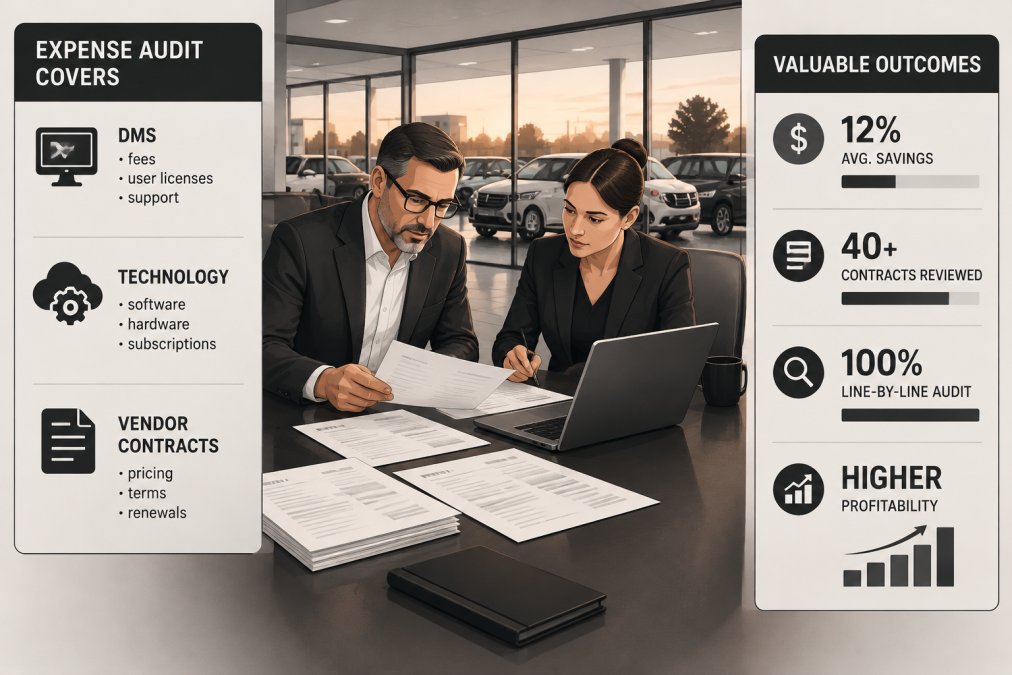
A proper audit is a structured review of vendor relationships and recurring charges. It looks at whether each product is needed, how billing matches the contract, and whether renewal and exit terms favor the dealer.
For a deeper walkthrough of the process and deliverables, read the independent dealership expense audit guide.
Inside a Dealership Vendor Contract Review: DMS, Technology, and Service Agreements
A dealership vendor contract review examines the agreements that quietly set your cost base for years: DMS, CRM, multi-point inspection tools, network services, and third-party integrations. These contracts are long, technical, and usually signed under time pressure during a system change.
What most guides miss is that the DMS contract is rarely the whole story. Hidden costs often extend beyond software into the personnel overheads managed by a recruitment agency for dealerships, where inefficient hiring practices drain resources just as surely as bloated technology contracts.
If your store runs multiple franchises or locations on different systems, a coordinated review matters more, not less. See how automotive DMS consultants handle pricing analysis and negotiation across those agreements.
DMS Cost Reduction Strategies That Protect Gross Profit
DMS cost reduction works best as a negotiation discipline, not a one-time cut. The goal is a contract that matches how your store operates today and holds the vendor accountable for what they promised.
Strategies that consistently work:
- Benchmark before you talk. Know current market pricing before the first conversation.
- Separate necessity from price. Removing a product you do not need beats arguing over a few dollars on one you do.
- Time the renegotiation. Renewal windows are use; missed windows are not.
- Document usage. Vendor claims about what you "need" are easier to challenge with data.
- Set escalation limits. Uncapped annual increases compound quietly.
For specific tactics, review these DMS contract negotiation tips. Watch out: renegotiating without benchmarks often produces a worse deal than the original, because the vendor controls the pricing narrative.
How to Evaluate ROI, Fees, and Engagement Length Before You Sign
Ask three questions before signing anything: what will this cost, what will it find, and how long will it take. Ask providers to put their method in writing.
Fee structures you will actually encounter
Profitability consulting for dealerships is priced in one of three ways, and each shifts risk differently:
- Fixed-fee engagement. A set price for a defined scope, such as a DMS and vendor contract review across a stated number of rooftops. Easiest to budget, but scope creep is billed separately, so the written scope definition matters more than the number.
- Contingency or shared-savings fee. The provider is paid a percentage of verified savings, usually over a defined measurement window. Aligns incentives, but the savings definition is where disputes start: is it first-year savings, recurring savings, or net of implementation cost?
- Hourly or day-rate. Common for implementation support and vendor follow-up after the diagnostic. Useful when you want help enforcing changes but not a full audit.
Most practitioners find a hybrid works best: a fixed fee for the diagnostic and findings, then a defined rate or success component for implementation support. Whatever the structure, get the scope definition in writing before the fee conversation ends.
How to test an ROI claim
Do not accept a savings promise. Ask for the calculation method and check four things:
- Baseline. Savings must be measured against what you actually paid, not a list price or a vendor's quoted rate.
- Period. First-year savings and recurring annual savings are different numbers. Ask which one is being quoted.
- Net versus gross. Savings net of fees and implementation cost is the only figure that matters to your bottom line.
- Verification. Who confirms the savings, the provider, your controller, or the vendor's revised invoice? Independent verification is stronger.
Ask providers whether a savings figure is gross or net of fees and one-time transition costs before you compare them.
Engagement length: the four phases
A credible engagement runs in phases, and the timeline should be stated up front:
- Diagnostic. Document collection and contract review.
- Findings and recommendations. A written report with line-item findings. Ask who presents it.
- Implementation. Renegotiation and vendor follow-up.
- Sustainment. Ongoing review of renewals and contract terms. Ask whether this is included or billed separately.
Get the full phase timeline and the fee for each phase in writing before you sign.
A Provider-Selection Framework for Dealership Profitability Consulting
A scorecard can help compare providers on substance rather than presentation. The framework below is built for a side-by-side comparison of two or three providers, and it weights the criteria that actually predict whether savings survive past the first invoice.
Step 1: Define your store profile first
Score the provider against your situation, not in the abstract. Write down:
- Rooftop count and franchise mix. A single-point domestic store and a multi-franchise group on different DMS platforms have different needs.
- Current systems. Which DMS, CRM, and third-party tools are in place, and how long since the last contract review.
- The problem you are solving. Rising overhead, a specific contract coming up for renewal, or a broad operational review.
- Internal capacity. Do you have a controller or office manager who can own implementation, or do you need the provider to drive it?
A provider who is strong for a five-rooftop group may be a poor fit for a single store, and vice versa. Fit is the first filter, not the last.
Step 2: Score on weighted criteria
Score each provider from one to five on every line, then apply the weight. Independence and implementation support carry the most weight because they determine whether findings turn into savings.
| Criterion | What to demand as evidence | Weight |
|---|---|---|
| Independence | Written confirmation the provider sells no software and takes no vendor compensation | High |
| Scope in writing | A scope document naming DMS, technology, and service agreements specifically | High |
| Benchmarking method | An explanation of where market pricing data comes from and how current it is | Medium |
| Multi-store capability | Named experience auditing across locations on different systems | Medium |
| Implementation support | A described process for vendor follow-up and enforcement after the report | High |
| References | Comparable stores, with permission to call, and outcomes stated in net terms | Medium |
| Fee transparency | Full phase-by-phase pricing before the engagement starts | High |
Step 3: Ask the questions that separate providers
- Who owns the vendor conversation after the report? If the answer is "you do," ask what support is included.
- What happens if a vendor refuses to move? A credible provider has a documented escalation path.
- How are findings prioritized? By dollar value, by ease of implementation, or by renewal date, the answer tells you how they think.
- What does the deliverable look like? A line-item report your controller can act on is different from a slide deck.
- What is the exit term? You should be able to end the engagement at a phase boundary without penalty.
Step 4: Check references against your profile
Ask for references from stores of similar size and franchise mix, and ask two questions the provider cannot script: what did the savings look like net of fees, and what did the provider do when implementation got difficult. A reference who cannot answer the second question is a reference who did not go through implementation.
A provider who cannot produce a comparable reference and a written scope asks you to buy on trust alone.
Find My Profit Leaks: Your Next Step With All Relative Inc.
The hardest part of this work is not the negotiation. It is accepting that the losses are real and probably larger than expected.
If your store runs multiple locations, complex vendor stacks, or contracts that have not been reviewed in years, an independent audit is the fastest way to find out what is leaking.
Get started with ALL RELATIVE INC. and find the profit you have already earned. You can start with a profit-leak review to see where your store stands.
Most dealerships do not have a revenue problem. They have an expense problem nobody has audited.
Frequently Asked Questions
How do third-party audits differ from standard dealership consulting?
Standard consulting often bundles strategy work with software or vendor recommendations, which creates a conflict of interest. An independent expense audit focuses on line-by-line review of DMS, technology, and vendor contracts without selling any product. All Relative Inc. acts as an independent advocate for the dealer rather than a reseller, and is founded in 2005.
What is the typical ROI for hiring a dealership profitability consultant?
ROI depends on contract volume, billing errors found, and overlapping products. Ask any provider for references from stores similar in size and brand, and request documented findings rather than projections. All Relative Inc. publishes pricing on its website, so you can review current pricing before committing.
How much of a lift is an automotive dealership expense audit on our team?
Confirm the scope upfront: single-store versus multi-rooftop, which departments are included, and who handles vendor communication after the audit.
What happens after the audit, and will vendors push back?
Ask any provider what happens after the report, including whether implementation support is included. All Relative Inc. combines market intelligence with pricing benchmarks, so negotiations can rest on data.